
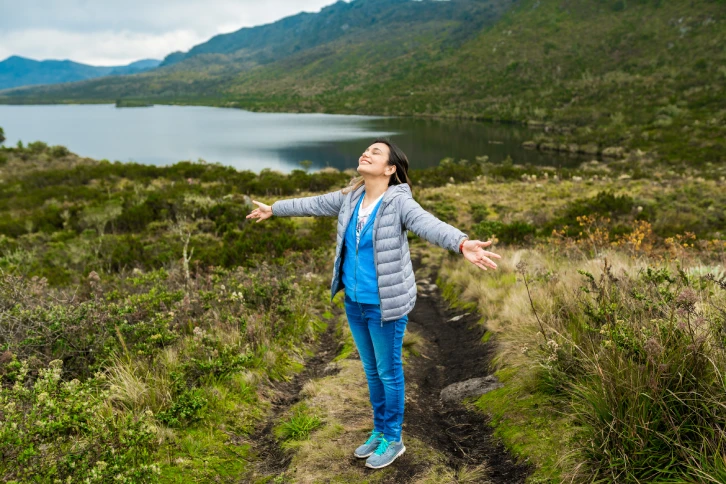

Somebody tells you to “just go for a walk” when you’re stressed, and it can feel almost insulting, like the suggestion doesn’t match the size of what you’re carrying. It’s such a small, ordinary piece of advice. It also happens to be backed by a surprising amount of research, more than most casual advice ever gets.
That doesn’t mean a walk fixes everything. It means something measurable is actually happening when people spend time outside, and it’s worth understanding what that something is.
The Research Behind “Go Outside, You’ll Feel Better”
One of the largest studies on this question tracked nearly 20,000 people in England and found something specific: people who spent at least 120 minutes a week in nature reported significantly better health and well-being than people with no nature contact at all, and it didn’t matter whether that time came in one long visit or several shorter ones spread across the week (White et al., Scientific Reports, 2019).
Below that threshold, the study found no meaningful benefit. Above it, the benefits held steady.
That’s not a small finding. It suggests there’s a real, identifiable dose, not just a vague sense that nature is nice.
The effect shows up specifically around mood, too. A recent systematic review and meta-analysis focused on older adults found that greater exposure to green space was associated with a notably lower risk of depression (systematic review and meta-analysis, 2025).
And a separate systematic review of nature-based therapeutic interventions found that several studies measuring cortisol, the body’s primary stress hormone, showed significant reductions after time spent in natural settings (systematic review, 2024).

What’s Actually Happening in the Body
Nature exposure seems to work through more than one channel at once. Time outside is linked to lower cortisol, which means a calmer stress response. It also tends to reduce rumination, the kind of looping, repetitive worry that keeps a bad mood circling instead of resolving.
Green environments in particular appear to give the part of the brain responsible for focus and self-control a genuine break, the way a muscle rests between sets, which may be part of why so many people describe feeling mentally “lighter” after even a short walk outside.
None of this requires wilderness. A city park, a tree-lined street, a backyard garden, all of it seems to count, as long as the exposure is real and not just a view from behind glass. The research doesn’t point to remote, dramatic nature as the requirement. It points to regular, accessible contact with anything green.
A Familiar Scenario
Picture someone who works a desk job and spends most evenings on a couch scrolling a phone, telling themselves they’re too tired to do anything else. The tiredness is real. It’s also partly circular: no movement, no fresh air, no natural light in the evening, all of which quietly deepen the very fatigue and low mood that make going outside feel impossible in the first place.
A friend convinces them to start walking a nearby trail for twenty minutes most evenings, mostly just to have company for the walk. Nothing about their life circumstances changes. But within a few weeks, they notice sleeping a little easier and feeling less like their thoughts are stuck in the same loop every night. It’s not dramatic. It’s also not nothing.
How Much Nature Actually Helps
Based on the research, a few practical guidelines emerge:
- Two hours a week seems to matter most. That’s roughly seventeen minutes a day, which is far more achievable than it sounds when broken down.
- It doesn’t need to be continuous. Several short visits appear to work as well as one long one.
- Green, specifically, seems to help. Parks, gardens, and tree cover show stronger associations with mood benefits than paved or built environments.
- Consistency beats intensity. A single dramatic hike does less for long-term mood than a steady weekly habit of shorter outdoor time.
Why This Matters More During Recovery or Hard Seasons
Nature access tends to get squeezed out first when life gets hard, exactly when it might help most. Someone managing anxiety, depression, or early recovery from substance use is often dealing with disrupted sleep, elevated stress, and a mind that won’t settle- the same mechanisms nature exposure appears to influence directly.
This is part of why experiential approaches that build in real time outdoors, working with animals, tending a garden, and structured outdoor activity, keep showing up in treatment settings. They’re not just pleasant additions or a break from “real” therapy.
They’re targeting some of the same physiological patterns that talk therapy and medication address from a different angle, and for people who find traditional talk-based sessions hard to open up in, that physical, hands-on entry point can matter a great deal.
When and How to Seek Professional Help
Time outside is a genuinely useful tool, and it’s not a replacement for professional care when mood symptoms are persistent, when substance use has become a coping mechanism, or when day-to-day functioning has started to slip. A therapist or doctor can help sort out what’s situational and what needs more structured support.
For people already exploring treatment, equine and horticultural therapy programs build nature-based approaches directly into the recovery process, combining the physiological benefits of time outdoors with structured therapeutic work rather than leaving one to substitute for the other.
If you’re in crisis or having thoughts of suicide, the 988 Suicide & Crisis Lifeline is available by call or text, any hour of the day.
Seventeen minutes a day outside won’t undo a hard year. It might be one of the more evidence-backed places to start rebuilding from one.
Sources
- White, M. P., Alcock, I., Grellier, J., Wheeler, B. W., Hartig, T., Warber, S. L., Bone, A., Depledge, M. H., & Fleming, L. E. (2019). Spending at least 120 minutes a week in nature is associated with good health and wellbeing. Scientific Reports, 9, 7730.
- Systematic review and meta-analysis of green space exposure and mental health outcomes in older adults, 2025 — https://www.ncbi.nlm.nih.gov/pmc/articles/PMC12882215/
- Systematic review of nature exposure therapies on stress, depression, and anxiety levels, 2024 — https://pmc.ncbi.nlm.nih.gov/articles/PMC10969128/
Please follow and like us: